Sunday, October 9, 2011

Like a Good Neighbor

The following took place between the hours of six and seven this evening, while walking my dog (cue the show 24’s beeping):

Neighbor 1: There’s the kid that lives down the street, just got back from the Peace Corps.
Neighbor 2: I heard he was in Mongolia or Tibet, somewhere mountainous.
1: Yes, it was Tibet. I wonder if he wears shoes inside.
2: Probably picked up the habit in China, does it backwards. Where does he think he is?
1: Maybe he’ll put some sandals on in the winter.
2: I bet he doesn’t wear shoes even if it snows.
1: Of course he has to put shoes on when it snows.
2: I don’t know, you never know. You know he sics that dog on children.
1: That dog is ferocious.

I was too embarrassed at first to talk to these chatty ladies. Then I got really annoyed and wanted to go back and correct them. However, by this point I was a couple meters from my house and just kept shuffling on.

I would like to clarify a few things, and can be as snarky as I want here without worrying about causing a situation for my parents.

- I live next door to you, not down the street.
- I did live in Mongolia, but the country is about as mountainous as your 40 year old daughter’s flat, WASPy, butt.
- I run down the street in my Adidas running SHOES every other day, and my daily shoes are a little run-down, but I still make a habit of wearing them whenever I leave the house.
- I do not “do it backwards,” nor do Asians in general. Sometimes they take off shoes inside, though
- Again, I lived in Mongolia. I did visit China, but I doubt anyone told you that part. I think you may believe that there is no difference between China, Tibet, and Mongolia.
- I will in fact wear boots in the winter, especially if there is snow.
- I have never encouraged my dog to attack children. Cara did, however, sic him on some field hockey girls, but they were in high school.
- The dog is a 25-30 lbs. dachshund/black lab mix. He is decidedly not ferocious.

What happened is that I took the puppy out for a walk rather late in the evening. Halfway through my sandal broke and I had to walk home on a street (without a sidewalk) that had recently been torn up for water pipe work. My left-foot sandal was missing, however I did still have one on my right foot.

I would like to take this opportunity to tell you, my neighbor, that if you want to be an actor, please pursue it. Your stage whisper carries with absolutely no acoustical aid. And please, don’t worry, the pebbles and acorns were both character and callous building …

- John

Thursday, October 6, 2011

Bad Apples

I gave it a day, but that's as good as I can do. I preface this with: I have nothing personally against Steve Jobs. As a person, he may have had plenty of positive qualities. The link I shared for his death is actually a great article that I agree with, those are his legacies, and they are at the core of what is wrong. As a businessman who had a profound impact of the world market, Steve Jobs has done humanity a great disservice.

To begin with, I do agree that sweeping generalizations do not work very well. The company, Apple, has not been entirely bad, or had no good products. In fact, Apple performs one great service to the market, which is providing products that are simple and relatively easy to use. The iPhones are sleek. An iPad looks like a lot of fun to play with. I even own an iPod, and my parents own an iMac.

I look to Apple when I am tired, when I am being lazy, or when I simply know my limits. I pressured my parents into buying an iMac before I left for Mongolia. Why? Because I couldn't be there to help them troubleshoot. The glossy characteristic of the operating system, and even the hardware itself, was a beautiful, enamel coating protecting the computer from my parents. Other computers do not give so little trust to their users, but Macs, they know that their users cannot be trusted. So Mac-users get big icons, simple docks, and even mice with only one button just so nothing gets too complicated. That is a wonderful thing! For users that have no urge to inform themselves better.

The same goes for my iPod. I wanted portable music, and I wanted it without having to do research. I admit it, and I picked up a device that I knew I could throw music on with nothing more than iTunes, and could put in a pocket while I exercised. Was the Zune better? Maybe not, maybe Creative Labs came out with something mind-blowing. I will never know because I admitted my limits, and admitted that I didn't want the best thing on the market, but the simplest.

The problem begins with people not admitting that. Whatever the reason, whether it's because everyone else has them, or they look cool, people begin to assume that these Apple products are the best things on the market and that they need them. Who actually needs an iPad? I believe there is someone at there that has found an iPad to be the best solution to some problem they've had, but for the majority, it's a novelty, a cool gadget. And that's great, I love gadgets, but the popularity of iPads does not make Steve Jobs an innovator, it makes him brilliant at marketing, and that's all.

Apple's obvious corporate strategy is consolidation and monopoly. Under the guise of making life easier, it consolidates your mp3 player with your mp3 store. It consolidates your phone with your music player. It consolidates your internet browser with your operating system. When Microsoft does this, it's a bad thing, and they get dismantled. Why can't we see that it can also lead to a bad situation when Apple does it too?

When iTunes came out, WinAmp, Sonique, Realplayer, and Windows Media Player all existed for music. Did iTunes, originally, do anything better than the competition? No, but it won out because of its integration with Apple products. I am not crying foul here, this is not a bad thing, it's simply the market working. However, it's not a good thing, either. We are now stuck with mp3 as the audio format of choice, instead of a lossless format, not necessarily because of any technical details, but because iTunes did not support flac and aac files.

It's the lack of personal research, encouraged by Apple, that is so problematic. Apple tells the consumer that it wants Apple products, and we as consumers have started to get confused and actually turn that message around and believe that we need Apple products. What we need is better understanding, more research, and more competition! As consumers, it is our duty to be informed, to push the market to create better and better products. When an iPhone comes out that boasts dual processors, say, "Nice job catching up, Apple," because my Photon has been performing well thanks to its two processors for months now. When you hear about using your iPad or iPhone as a credit card, feel free to sound snobby and inform them that the technology is called Near Field Communications and has been around for a while now. Do not feel guilty, because there are plenty of half-informed Apple users out there ready for you to be as uninformed as they are and take that tone with you.

Allow yourself guilty pleasures, I have my iPod with Ke$ha on it, I admit. But do not spend your whole life lounging on the sidelines, letting companies tell you what you want. That is Steve Jobs' real legacy, and it's a poor one indeed.

- John

Saturday, October 1, 2011

Putting Together 2 and 2 and Getting 99

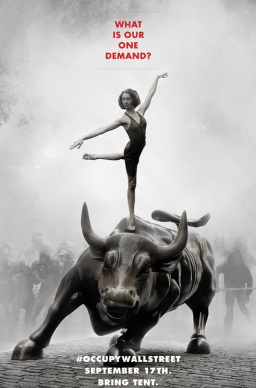
A friend recently shared a link to We Are the 99 Percent, and I'm beginning to think that all I need for inspiration to post here is Facebook and 10 minutes to scan my news feed. The tumblr account (which is really a blog service for people who like pictures better than words) has stemmed from the Occupy Wall Street movement.

If you missed this display of idiocy in motion, Occupy Wall Street is an exercise in proving that Alexander Hamilton was on to something with Federalism, and that the average human cannot intelligently handle both the responsibility and privilege of democracy.

The Daily Show has covered it (and if you don't see Jon Stewart as at least as viable a news provider as these guys in bow ties, then we really have no common ground to meet on). Stewart does a pretty reasonable job commenting on the ridiculousness - Bonaroo-esque - and then moving past a subject he could just hammer away at. However, maybe he assumes that his colleague on the Colbert Report has covered it, but the absurdity at the heart of the protests is glossed over. These people are gathering, apparently trying to lower or halt the (admittedly low) productivity of Wall Street, without actually having any goals or demands. The know they want things, but are still TRYING TO DECIDE WHAT THEY WILL DEMAND. That is unacceptable. Protests are a result of making decisions, not the process.

To top it off, now WA99P - the website the started this post - has sprouted up in order to apparently put faces on the Occupy Wall Street movement. It features a bunch of pictures of individuals holding up paper with their financial woes written on them. One continual complaint is student loans. These are loans that almost everyone has had to take out. They are also completely voluntary, and usually taken out in spite of options for state and community colleges. It sucks, but education costs. Then, the question arises that if these people have so much debt weighing them down, where are they getting the time and money to post these pictures on what are probably personal internet connections? Finally, what are they 99% of, anyways? Who, then, is the 1 percent? Are they lonely?

The website and movement itself reek of people feeling like they're owed something. What are they owed? They have free speech, as evidenced by the existence of both a protest and online soapbox. Quite a few have jobs, even if they're not making as much as they think they need. So, is that the heart of the problem, money?

Since when did it become okay for Americans to demand money? One of my greatest frustrations in Mongolia was a pervasive mindset that their neighbors with more money and technology owed them handouts. Directors of schools and medical institutions routinely expected money out of volunteers, disregarding any other benefits they could bring. Now I'm back in the States and hearing the same self-interested demands.

Oh and don't even get me started on any of the "creative" people posting on that website. You don't get money for random artistic creations that have little to no market? I'll try to look surprised, but I promise nothing. Find a patron, or find a job. I'm calling you out on this, if you're a real artist, you can't help but create. Work a commercially viable job, and live your art.

Coming up next, finally some of the posts I made before leaving Mongolia,
- John

Wednesday, September 14, 2011

Rectifying Regional Views

I seem to remember reading in an article on letter writing etiquette that one must never begin with an apology. I don't really care for rules like that, but I do usually enjoy anecdotal openers anyways. However, apologies should be gotten to quickly, so I'm sorry for the two week absence.

September brought with it Cara, my girlfriend. She, like myself, was serving in Peace Corps - Mongolia. We spent some time traveling through China together after finishing our two years of teaching English. Then I met family in Italy while she went back to the States for a few weeks before touring Scotland with her mother.

Fast forward a month and Cara has allowed herself to be convinced to visit me in St. Louis. She met my mother before leaving Mongolia, but handled meeting the rest of my family with panache. To reward her "reckless courage," as well as rectify her view of Missouri as "Southern," I took her to every interesting event I could find during her two week stay.

One of the highlights for me was the Japanese Festival at the Missouri Botanical Gardens. I have tried to always make the festival when living in St. Louis, but after two years in Central Asia, the cultural event was that much more enjoyable for me. I do not want to pretend that I know really anything about Japan just because I lived in Mongolia, but that didn't stop me from mentally mocking the high school kids running around in kimonos and baby doll outfits.

Arguably the best part of the festival happens after nightfall, when candles are lit around the Japanese garden area and lake for an evening walk. However, for this year, my favorite part was a cooking demonstration.

To understand what follows, you need to know two things. First, Cara often criticizes me for being too negative and judgmental. I argue that the two go hand in hand with a realistic world-view. When you open your eyes, you have to start judging what's good and what's bad, and the sad fact is that there is a lot of bad. Second, during our travels throughout Asia, Cara and I have made a point of attending cooking classes wherever we are.

The demonstration included nine relatively quick and simple Japanese dishes prepared over the course of an hour and a half. That part was on the brochure, the surprise was that it also included the cook's views on Asian culture. He talked about the recent nuclear disaster and resilience of the Japanese. He enlightened us on how escalators only go up, but not down in order to save power. He even gave a culinary version of Asiatic differences:

Cook: "You take this and this [soy sauce and mirin] and you know you're cooking Japanese, right?"
Crowd: "Yes," with a little laughing.
Cook: "Well how about take away the mirin and add garlic and chili peppers. Where are you?"
Me: "China?" among other mumbles from the crowd.
Cook: "Korea, you should have gotten that with the garlic alone. What about adding ginger?"
Crowd: "China," with a little confidence.
Cook: "Right, China. And take away ginger, leave soy sauce, add tomatoes?"
Me, much more quietly this time: "Italy?"
Cook: "Indonesia, yeah, not Italy. This is about Asia ..."
Obviously I was not alone in my guess.
Cook: "And add cardamom, and pepper, and cloves, and ..."
Crowd: "India!" Emphatically this time.
Cook: "Good, India, and that's a history of Asia with just a handful of ingredients."

Cara, who had remained rather quiet throughout the exchange leans over to me and whispers:
"And take away everything? Mongolia!" She dissolved into giggles as she had obviously been holding that one in.

Cara and I may still disagree on which region to put Missouri in, but at least we have a consensus on Mongolia,
- John

Sunday, August 28, 2011

Self-Image

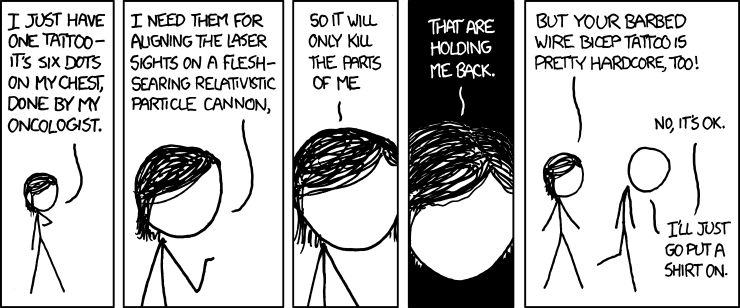
Forewarning: I like tattoos. I think a tasteful one definitely makes a guy look cooler and a lady look hotter. I even have a couple fairly sizable ones myself. That being said, it's always great to take a step back, take a look at other people, and take a second more objective look at yourself. Remember that no matter how badass you ever become, there is someone out there more hardcore than you. If that doesn't depress you, hopefully it takes a burden off your shoulders and you can stop trying so hard (*cough* poser *cough*).


Image from XKCD, not my property, but the author is a ridiculously chill guy who agreed a long time ago that if I ever did make a novel, I could use this strip for the cover. Obviously, I need to seriously get down to business and crank out the book. By the way, hover your mouse over the comic in either link for extra amusing commentary.

Saturday, August 27, 2011

Love Doesn't Make the World Go Round ...

My friend Hilary recently made a post in her blog that I enjoyed reading even though I disagree with the general outcome. She describes a frustration over sentimentality that many writers can sympathize with, feeling as if you're perpetually writing about love. A lot of readers are probably frustrated by the same thing.

If you're curious about how I feel, go check out the comments, and while you're there, seriously look at the entire blog, it's a fantastic read. In honor of my car purchase this morning (2002 stick-shift Mazda Protege with more miles on it than my suitcases) I want to talk about love, and how it's all about adjusting.

I don't crush a lot, I fall in love. A whole lot. My way of falling in love is a continual adjustment between loving what's in front of me and loving what it could be. For example, while buying cars I fell for each one pretty quickly, then got disgusted by the issues they had (torn seats, wide turns, dents). Yet the love returned as fast as it left when I imagined what I could do with them after a little work.

That type of oscillation is exhausting, and I think it takes different forms in people. I know a woman who lives out Plath's quote about neuroticism (about ten quotes down, or CTRL+F "neurotic"). The misogynist in me would say that all women want two mutually exclusive things at the same time, maybe more. The misanthrope would say who doesn't? What I like about the quote is she describes herself as flying "back and forth" between the two. It's not pure craziness. She doesn't want eat and talk at the same instant, or really express a desire to combine her two desires. One second she wants breath, and one second she wants to hold her breath. This seems neurotic, but at the root, by adjusting and giving in to each desire at the appropriate time, isn't that how we live?

The line between happiness and misery is accepting that every time you adjust, you will probably have to adjust again (maybe even sooner rather than later). Enjoy that today you'll wake up wanting someone to talk to, and tonight you'll go to bed wanting someone whose conversational skills are lacking (or vice versa). Enjoy that maybe you won't be able to talk to the one person you want to talk to right now, but maybe she'll be around tomorrow, when you don't feel like talking. It's funny, and it's crazy, and it's all about love.

Because love doesn't make the world go round, it makes it more sine-uous,
- John

Friday, August 26, 2011

Angels and Demons but No Dan Brown Quotes

A brief update on the car-hunt: still hunting. My mechanics, Tony and Rick, are awesome and being incredibly patient while they inspect each stray that I bring in. The 2004 Elantra I was looking at broke my heart and the master cylinder in the clutch system. A post for another time is the rather risque master and slave terminology used in cars and computers. I had a lead on a '97 Prelude that is apparently back in the shop (but will be ready Monday ...) and now I'm looking at an '02 Protege that is a little frumpy but possibly well cared for.

When I haven't been stressing and suppressing my auto-worries by stuffing food down my throat, I've been trolling on Facebook. I find it extremely useful to mind-numbingly scroll down the news feed and take a minute to see what my "friends" are doing. Sometimes it's a little depressing (I read a similar article to this one in Cosmo first, embarrassingly). Sometimes it gives me a chance to catch up on the lives of people that I care about but don't quite find the time or a way to connect with in real life. And sometimes you find those little things like updates or quotes that annoy you until something bursts.

I feel guilty because recently I gave in to making a rude comment about one of those things. One of my guilty pleasures also feeds into a pet peeve - I love checking out the quotes that people record in their information, but I am incredibly snobbish about bad quotes. I'm sure you've seen the quote commanding you to "be the change you wish to see in the world," from Gandhi. At this point in time, I hate that quote on multiple levels, but mostly because everyone knows it. Why not put next to it "Do unto others ..." or any other form of the Golden Rule? But that isn't as cool as implying that maybe you're deep enough to have picked up "The Way to God," or Gandhi's Book of Prayers.

The quote that currently tops my list is by Marianne Williamson. It claims that thinking that we fear inadequacy is a misconception, while what we truly fear is our enormous strength. At first it seems to imply that if we recognize our potential consciously, we might feel the need to measure up, but then the quote jumps around and refutes itself. She says that we ask ourselves: "Who am I to be brilliant, gorgeous, talented, fabulous?" So the fear goes back to actually worrying that we're not as great as we seem.

Thinking that God is inside of all of us can be reassuring. However, believing that all of us ARE in fact God, is horrifying. The concept of God is a hope that there is something better than us, something perfect, all-powerful, and all-knowing (at least one concept of God, that is). To further cripple her own quote, Williamson goes on to say that by letting our light shine, we allow others to do the same. I am all for letting light shine, but sometimes bushels are useful for hiding. Think about it like this: the light on your cell phone screen looks awesome in the dark, but as soon as you take it outside, it is practically useless. Some lights are dimmer than others, and if you're brilliant and always shining, there is someone dimmer than you that is going to feel pretty awful standing nearby.

While I might fight tooth and claw against the idea of everyone being God, don't think that I'm inflexible. Why not meet me halfway? We are definitely not gods, but maybe we're angels and demons. And why not? Exorcisms were performed on people before mental disorders were understood. The ancients thought that demons could inhabit a person, which was may not have been right, but a finger pointing in the right direction. I've never seen a demon or an angel, except on another person's face.

It might seem like splitting hairs, saying we're angels instead of gods, but the difference is hubris. The difference of pride is the difference between being the Morning Star, and being Satan. In other words, the difference is at your core, whether you might tend towards fiending or friendliness.

I certainly have a little Tyrion in me,
- John